Key Takeaways
- Ceer, Saudi Arabia’s first homegrown car brand, unveiled its EXOBOT electric sedan and SUV in King Abdullah Economic City on 21 September 2026.
- Top trims offer 1,111 hp, a 670-km range and 0–100 km/h in 2.1 seconds. Production is slated for January 2027 and deliveries for March 2027.
- The plant targets 170,000 vehicles a year and about 30,000 jobs, and Ceer is projected to add US$8bn to Saudi GDP by 2034.
- Ceer is a PIF–Foxconn joint venture, working with partners including BMW, with seven models planned over five years.
- Australia’s critical-minerals strength and existing Saudi partnerships put it in a strong position to support the Kingdom’s growing EV value chain.
On Monday night in King Abdullah Economic City, Saudi Arabia did something it had never done before. It showed the world a car it designed, engineered and will build at home.
A Night Three Years in the Making
Ceer revealed the designs of its first two models at its manufacturing facility in King Abdullah Economic City. PIF Governor YasirAl-Rumayyan attended the global unveiling, alongside industry representatives. Crown Prince Mohammed bin Salman, who is also Chairman of the PIF Board, revealed the EXOBOT himself.
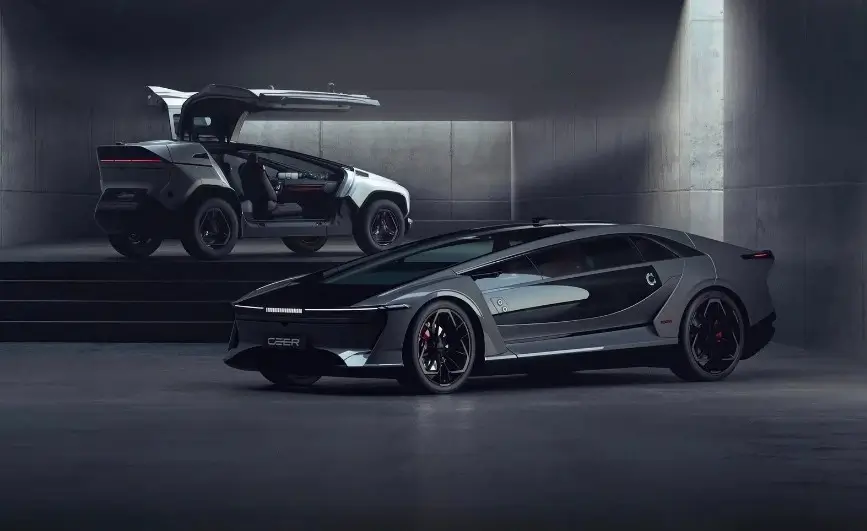
Element Value File name ceer-exobot-sedan-suv-saudi-arabia-ev.webp Alt text Ceer EXOBOT electric sedan and SUV, Saudi Arabia’s first homegrown vehicles Title attribute Ceer EXOBOT unveiled in King Abdullah Economic City Dimensions / format 1200×630px, WebP Loading eager Caption Ceer’s EXOBOT sedan and SUV, the first two of a planned seven-vehicle lineup. ASBF Blog — Ceer EXOBOT: Saudi Arabia’s First Homegrown EVs Page 2 of 5 For CEO James DeLuca, the evening capped three years of work on the company’s first vehicles. He also confirmed that cars wearing the “Made in Saudi Arabia” badge will soon reach customers everywhere.
The Crown Prince described the launch as another step in building a sustainable industrial ecosystem. He framed the automotive sector as a key driver of economic growth that attracts investment, empowers national talent and positions the Kingdom as a regional and global hub for the industry.
Meet the EXOBOT
The EXOBOT comes as an electric sedan and an SUV. They are the first two of seven vehicles Ceer plans to launch over the next five years, and the lineup will span compact to midsize models.
The design is unmistakable. Both models are wedge-shaped, with dramatic gullwing doors, 112-kWh batteries and 800-volt charging. The audience applauded when the top-trim figures were revealed: 1,111 horsepower, a 670-km range and 0–100 km/h in 2.1 seconds.
According to Autocar, series production is set to begin in January 2027, with first deliveries planned for March 2027.
Five Numbers That Tell the Investment Story
170,000. Ceer’s manufacturing complex is being developed for annual production of up to 170,000 vehicles.
30,000. The project is expected to create about 30,000 direct and indirect jobs.
US$8 billion. Ceer is projected to add US$8 billion, or more than SAR 30 billion, directly to Saudi GDP by 2034.
45%. The company is targeting 45 per cent local content in its vehicles, which deepens the domestic supplier base.
7. The EXOBOT pair are the first of seven planned vehicles, which gives the company a multi-year product pipeline.
Built on Global Partnerships
Ceer is a model of how Vision 2030 brings world-class partners into the Kingdom. The Public Investment Fund founded the company in 2022 in partnership with Foxconn, the Taiwanese manufacturing giant. Since then, Ceer has built its engineering and ASBF Blog — Ceer EXOBOT: Saudi Arabia’s First Homegrown EVs Page 3 of 5 manufacturing capabilities with partners including BMW and a long list of major suppliers.
The result is a flagship Vision 2030 project that supports the national plan to diversify the economy and reduce reliance on oil. It turns investment into factories, skills and exportable products.
What It Means for Australia
A new automotive manufacturing hub needs one thing above all: a reliable supply chain for the materials inside every electric vehicle. Australia is the world’s largest lithium producer and a major supplier of critical minerals, and it has a mining partnership with Saudi Arabia that is already growing. As Ceer scales toward full production, that shared interest in the EV value chain becomes more significant for both countries.
There is also opportunity beyond minerals. A growing Saudi auto sector will create demand in engineering services, automotive software, logistics, skills training and advanced manufacturing, all areas where Australian firms have expertise. With direct Saudi–Australia cargo links now in place, the corridor for that kind of collaboration has never been more open.