Across Australia, patients have become used to their doctor asking a new question at the start of an appointment: is it okay if AI takes the notes? The company behind the most widely used of those tools has now attracted one of the largest healthtech raises in Australian history. It has also said the Middle East is on its expansion map.
Key Takeaways
- Melbourne-founded Heidi raised US$340m, including a Blackbird-led US$100m Series C, at a valuation of US$900m (≈A$1.26bn).
- Recurring revenue grew fiftyfold in two years, and the platform supports about 2.8 million patient visits a week across 190 countries.
- Heidi is moving from AI documentation to clinician-supervised AI agents.
- The company plans to expand into Asia and the Middle East.
- Saudi Arabia’s Vision 2030 health transformation and a digital health market projected to reach US$11.07bn by 2033 make the Kingdom a strong fit for Australian health AI.
The Deal at a Glance
Item | Detail |
Company | Heidi (Melbourne) |
New funding | US$340m (≈A$478m) |
Equity round | US$100m Series C, led by Blackbird |
Growth capital | US$240m from General Catalyst’s Customer Value Fund |
Valuation | US$900m (≈A$1.26bn) |
Weekly patient visits supported | ~2.8 million |
The US$100 million Series C equity round led by Blackbird lifted Heidi’s valuation to US$900 million, or A$1.26 billion. A separate US$240 million growth investment from General Catalyst’s Customer Value Fund brings total new funding to US$340 million and lifetime capital raised to US$436.6 million. Existing backers Phoenix Court, Point72 Private Investments and Headline also took part in the round.
From Note-Taker to Care Partner
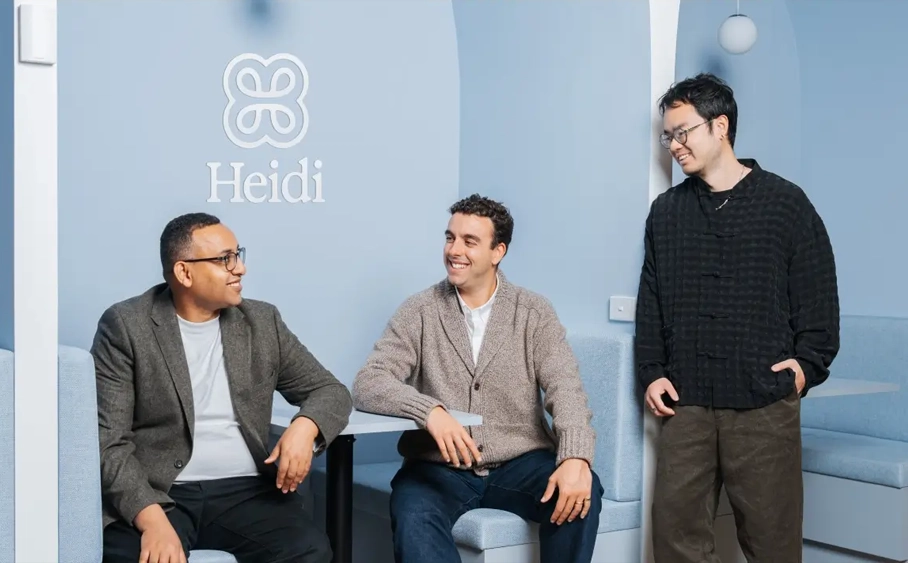
Heidi began as an AI scribe. Founder and CEO Dr Thomas Kelly, a former vascular surgery resident, built it to take documentation off clinicians’ plates. The ambition, in his words, “was always bigger than writing doctor’s notes.”
The new capital funds the next step: supervised AI agents. In the near term these agents will handle tasks such as clinical coding, patient follow-up and ongoing check-ins, with a doctor approving each action. Heidi has also broadened its product set with Evidence, which gives clinicians access to medical research at the point of care; Remote, a dedicated audio-capture device; and Dictate, a voice-to-text feature.
Growth That Global Investors Noticed
The numbers explain why investors backed the round with conviction:
- Annualised recurring revenue grew from US$1 million to US$50 million in two years.
- The platform now supports 2.8 million patient visits each week across 190 countries and 110 languages.
- The valuation nearly doubled from the US$465m Heidi carried at its Series B last October.
- Blackbird, Heidi’s first backer, has described it as the fastest-growing company in its portfolio, ahead of Canva.
At home, adoption is broad. Around 40% of Australian GPs were using an AI scribe by late last year, up from 22% in 2024, according to an RACGP poll. Heidi’s software is deployed at the Royal Children’s Hospital Melbourne, Children’s Health Queensland and Metro South Health in Brisbane.
Built on Australia's Trusted Foundations
Part of Heidi’s appeal to international health systems is where it comes from. Australia’s Therapeutic Goods Administration has stated that its 2024 AI review found the national regulatory framework to be fit for purpose and flexible enough to accommodate emerging technologies. That gives innovators a clear, stable environment to build in.
Heidi says it aligns with leading healthcare and privacy frameworks, including NHS requirements, GDPR, HIPAA and the Australian Privacy Principles. Co-founder Waleed Mussa has said the company keeps a constructive relationship with regulators and briefs them in advance on what it plans to build. For health systems weighing AI partners, that kind of track record matters.
Why Saudi Arabia Is a Natural Next Market
Kelly told Bloomberg the company plans to add as many as 150 staff over the next year and to push into Asia and the Middle East. Few markets in the region are moving faster on digital health than Saudi Arabia.
The Kingdom is advancing a health model centred on AI and medical robotics as part of a Vision 2030 transformation aimed at improving service quality and operational efficiency. Health Minister Fahad Al-Jalajel has said healthcare now contributes 5% of Saudi GDP, with service coverage reaching 97.4%. Saudi Arabia’s digital health market is projected to reach US$11.07 billion by 2033, with investment increasingly focused on deploying AI across clinical workflows, diagnostics, hospital operations and patient engagement.
The ecosystem is also highly connected. Riyadh’s Global Health Exhibition, running 26–29 October 2026, will bring together healthcare leaders, policymakers, innovators and technology providers to explore how AI and digital health are improving patient outcomes. It is a natural stage for Australian health-tech companies looking to meet Saudi partners.
Where the Two Stories Meet
Heidi’s rise reflects a pattern ASBC&F has been tracking all year, and it’s a story close to home. Miriam Makki, Board Member of ASBC&F, leads policy and government affairs at Heidi and has been part of the team helping the company build trust with governments and regulators as it grows. Australia is producing globally competitive technology companies, and Saudi Arabia is building one of the world’s most ambitious digital economies. Each needs what the other offers. Australian innovators bring proven, clinically trusted products. Saudi Arabia brings scale, investment appetite and a national mandate to modernise healthcare.
As Australian health-AI companies look to the Gulf, the Australia–Saudi corridor is well placed to become one of the most productive routes for health innovation in the coming decade.


